
Growing regions: altitude, rainfall, flowering, and what the ground does to the cup.
The twelfth man of Indian coffee: Yercaud and the Shevaroy Hills
Yercaud coffee, explained: 1,000 to 1,500 m in the Shevaroy Hills, arabica-dominant, planted since 1820. How it compares to Chikmagalur and Coorg.
Name an Indian coffee region and you will say Chikmagalur or Coorg. Almost nobody says Yercaud.
It is not a small place and it is not a new one. Coffee has grown in the Shevaroy Hills of Tamil Nadu since 1820, which makes this one of the oldest planted coffee belts in the country. It grows arabica at altitudes that most of Coorg cannot reach. And it has spent two hundred years being left out of the conversation.
Every side has someone like that. The twelfth man is not a lesser player. He is part of the side, he does the work, and the scorecard has no column for him. We buy our coffee from these hills, so this is the column.
Where the Shevaroys are, and what makes them unusual
The Shevaroys are a compact massif in the Salem district of Tamil Nadu, with Yercaud at their centre. Compact is the operative word: this is not a sprawling belt like Kodagu but a tight range where most estates sit between 1,000 and 1,500 metres above sea level.
Two things follow from that geography.
Rainfall is moderate and arrives twice. The hills take roughly 1,500 to 1,800 mm a year, bimodally distributed, with a dry season that is sharp and clearly defined rather than drifting. A defined dry season matters more than most people assume: it lets a planter dry coffee on the patio with some confidence about the weather, which is half of what separates a clean cup from a defective one.
Flowering is unusually uniform. Blossom showers in March set flowering off across the range at close to the same time, which means cherries on a given block ripen together. Uniform ripening is what makes selective picking practical. Where flowering is staggered, a picker faces green, ripe and overripe cherries on the same branch and the lot is only as good as their patience.
1820: a Collector, and some plants from Arabia
Indian coffee's founding story belongs to Baba Budan, who is said to have carried seven beans from Yemen to the hills above Chikmagalur. It is a wonderful story and it is a legend: undated, unwitnessed, retold.
Yercaud's story has a date and a name.
In 1820, M. D. Cockburn, then Collector of Salem, visited the Shevaroy Hills and planted coffee brought from Arabia. He served as Collector until 1829 and spent those years developing the hills, first coffee and later pears and apples across the hill stations of the Madras Presidency. He is still called the Father of Yercaud. The small hut he put up became Grange Estate, which is still there.
That makes the Shevaroys one of the earliest European plantation belts in southern India outside Mysore territory. Chikmagalur has the better story. Yercaud has the paperwork.
Two centuries of continuous planting is not a marketing line. It is why the estates here are small, long-held and strange. Ownership runs through families rather than companies. Blocks were laid out before anyone had a theory about what altitude does to a bean. Some of what works here works because somebody's great-grandfather noticed it did.
What altitude and shade actually do, and one thing they do not
You will read that shade-grown coffee tastes of whatever grows beside it. That the pepper vines and the cardamom and the orange trees pass their flavour into the bean.
They do not. A coffee plant takes up water and dissolved minerals through its roots. It does not take up the aroma compounds of its neighbours, and nothing travels from a pepper vine into a coffee cherry. If the cup tastes of warm spice, that came from the varietal, the ripeness at picking, the fermentation and the roast, not from the plant next door. We would rather tell you that than sell you a nicer sentence.
What shade and altitude really do is slower and more interesting.
Altitude slows the fruit down. Higher up, nights are colder and the cherry takes longer to go from set to ripe. A long ripening lays down more sugars and more of the precursor compounds that roasting turns into aroma, and it produces a denser, harder bean. Density is not a flourish. It is why a high-grown bean takes heat differently in the roaster and holds its sweetness through a medium roast instead of going flat.
Shade keeps that slowness going. A canopy of silver oak, jackfruit and native trees takes the edge off the afternoon, buffers the dry season, and holds the soil together on slopes where rain would otherwise take it. The trees are doing agronomy, not seasoning.
There is a limit, and good planters know it. Shade that is too dense slows drying and invites fungal problems where the air sits still. A well-run estate is thinning the canopy as deliberately as it planted it.
What actually grows in the Shevaroys
Arabica dominates. Robusta is grown on the lower margins, where the elevation drops off, but the hills themselves are arabica country. That is unusual in India, where the national crop leans heavily the other way.
The varietals are the old Indian selections. S795 is the reliable one, a mid-century selection, rust-tolerant, and the backbone of a great many Indian cups, alongside later rust-tolerant selections such as Cauvery and Chandragiri. Tipperary, one of the two estates we buy from, grows Selection 9 and 5B. None of these are fashionable. All of them are here because they survive what these hills throw at them.
Every Indian coffee is hand-picked, pulped and sun-dried. What decides whether a lot is called washed or natural is what happens at the pulping stage: whether the fruit comes off the bean before drying, or dries on it.
And this is the part worth knowing: washed arabica is the uncommon one here. Taking the fruit off, fermenting the mucilage away and washing the bean clean takes water, equipment, labour and a planter willing to take a lot apart into grades. In the Shevaroys that happens mainly on the larger, specialty-minded estates, the ones that have decided to compete on cup quality rather than tonnage.
So when you find a washed Shevaroys arabica, you are not holding the region's default. You are holding the lot somebody chose to make harder.
Yercaud against Chikmagalur and Coorg
The honest comparison, because you are probably making it:
| Yercaud (Shevaroys) | Chikmagalur | Coorg (Kodagu) | |
|---|---|---|---|
| State | Tamil Nadu | Karnataka | Karnataka |
| Typical altitude | 1,000 to 1,500 m | high arabica band; Baba Budangiri blocks reach 1,500 to 1,600 m | 750 to 1,100 m |
| Species lean | Arabica dominant, robusta on the lower margins | Arabica in the higher blocks, robusta below | Robusta-heavy; arabica in high, shaded pockets |
| Rainfall | 1,500 to 1,800 mm, bimodal, sharp dry season | varies widely; wet Malnad belts, drier east | 1,000 to 2,500 mm |
| Known for | being unknown | the founding legend, and India's best-known coffee name | volume, as India's largest producing district |
Read across the altitude row. Coorg, which most people treat as the benchmark, mostly sits below the Shevaroys. That is not a criticism of Coorg. It is a robusta landscape and it produces superb robusta. But if you are looking for Indian arabica grown high, Yercaud belongs in the conversation and is rarely in it.
Chikmagalur goes higher at the top end, and its best blocks are extraordinary. It also has eighty years of research infrastructure, a famous name and a legend. What it does not have is a reason for Yercaud to be invisible.
What a Fine Cup Award actually is
It gets printed on bags without explanation, so: the Fine Cup Award is run by the Coffee Board of India and has been held annually since 2002. Growers enter lots; the lots are cupped blind through a pre-jury round, then a national jury, then an international jury of cuppers drawn from outside India. Categories cover Best Arabica, Best Specialty Arabica, Best Robusta and Best Specialty Robusta. A recent year drew more than four hundred samples from across the country.
It is a competition between India's own estates, judged on the cup and nothing else. Nobody buys their way onto that list.
The two we buy
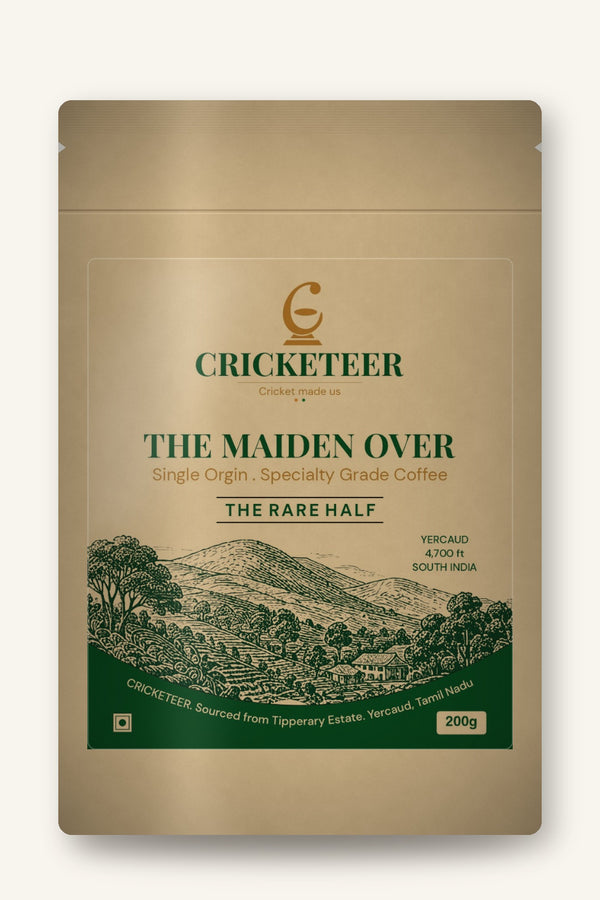
Maiden Over - The Rare Half. Tipperary Estate, Shevaroy Hills, grown at 4,700 ft, about 1,430 m, the top of this region's band. Washed, which as above is the uncommon processing here. Cupped at 82.6, and placed in the top five Arabica Washed coffees at the 2026 Fine Cup Award. 200 g.
Morning Session - The Champions Blend. A South Indian filter blend, 70% arabica and 30% chicory, from Pambukkal Estate in Yercaud, roasted medium-dark. The estate's arabica took second place in the Arabica Washed category at the 2025 Fine Cup Award. That award belongs to the estate's lot, not to this blend, and we will keep saying it that way. Chicory is not a cheapener here. It is what makes a filter decoction behave the way the South expects it to, thick and dark with the sweetness that holds up to milk. 250 g.
One is for the cup you sit with. One is for the degree-coffee tumbler at 6am before a match. We are not going to pretend they are the same thing.
Why any of this matters to us
We are not a coffee company. We are building a brand for the people cricket is actually made of: the parent who drove to the nets, the coach who stayed late, the friend watching at 3am in another country. The scorecard records the batsman. It has never had a column for them.
Cricketeer is about backing, and Yercaud coffee needs backing, and a rightful place in India's coffee culture and history, much like the colonial cricket culture it grew up beside. The British brought the crop here, and they brought the game. What we are backing is the champion spirit of the growers and the farmers.
The twelfth man is on the team sheet. Somebody should say so.
Questions people actually ask
Is Yercaud coffee arabica or robusta? Arabica dominates the Shevaroys. Robusta is grown on the lower margins where the elevation falls away. That makes Yercaud unusual in India, where the national crop leans robusta.
What altitude is Yercaud coffee grown at? Most estates sit between 1,000 and 1,500 metres above sea level. For comparison, Coorg, India's largest producing district, is mostly at 750 to 1,100 m.
How is Yercaud coffee different from Chikmagalur coffee? Chikmagalur reaches higher at the top end and has the famous name and the founding legend. Yercaud is a compact, arabica-dominant range with a dated planting history from 1820, a defined dry season and uniform March flowering. The practical difference for a drinker: Chikmagalur is easy to find, Yercaud is not.
Does shade-grown coffee taste of the pepper and spices grown beside it? No. Coffee plants do not absorb aroma compounds from neighbouring crops. Shade works by moderating temperature and slowing ripening, which develops sugars and produces a denser bean. Flavour comes from varietal, ripeness, processing and roast.
What is the difference between washed and natural coffee? Every Indian coffee is hand-picked, pulped and sun-dried. The difference is made at the pulping stage: a washed coffee has the fruit removed and the mucilage fermented off before drying, a natural one dries with the fruit still on.
What is a good cup score? On the 100-point specialty scale, 80 and above is specialty grade. Above 82 is a good lot. Above 85 begins to be rare.
When is the harvest? Flowering follows the March blossom showers, and picking runs in November, when only the ripe berries come off.
The coffees in this story

Stay close to the game.
New drops, stories from outside the rope and things worth sending to the group chat. No spam.